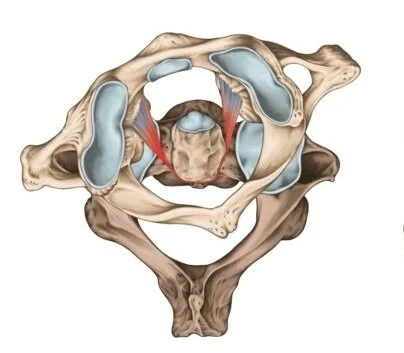
Cranio-cervical Instability (CCI)
The Truth About Craniocervical Instability
The top of the neck is not fragile by accident. It is engineered for movement.
The craniocervical junction—where the skull meets the upper cervical spine—is responsible for a significant portion of head rotation, nodding, and fine motor control. That design makes it naturally less rigid than the rest of the spine.
Instability here isn’t a flaw. It’s the trade-off for precision motion. Problems arise when the systems that stabilize that motion are compromised.
Designed for Rotation, Not Rigidity
The atlas and axis are uniquely shaped to allow freedom of movement while protecting the brainstem.
This region provides:
Roughly 50% of total neck rotation
Continuous micro-adjustments for balance and orientation
Fine-tuned communication between the head, eyes, inner ear, and brain
Because of this, bone alone is not the primary stabilizer. The real stability comes from soft tissues.
Soft Tissues Are the Primary Stabilizers
The craniocervical junction relies heavily on:
Deep suboccipital muscles
Ligaments that guide and limit motion
Fascial tension systems that maintain balance
These structures act like tension cables on a suspension bridge. The bridge isn’t unstable because it moves—it becomes unstable when the cables lose integrity.
If those soft tissues are damaged, overstressed, or neurologically disorganized:
Motion becomes poorly controlled
Joint mechanics lose precision
The brain receives distorted positional information
That’s when symptoms may begin to appear.
When Structural Integrity Is Compromised
Loss of soft-tissue stability doesn’t stop movement—it creates uncontrolled movement.
That can lead to:
Excessive or asymmetrical motion at the atlas
Abnormal loading of the brainstem region
Altered proprioceptive signaling from the neck
Increased protective muscle tone and tension
Neurological symptoms don’t appear because the neck moves. They appear because the nervous system no longer trusts the movement.
Neurology Always Responds First
When stability is compromised, the nervous system adapts immediately.
It may:
Increase muscle tone to create artificial stability
Alter posture to reduce perceived threat
Change motor patterns to protect the brainstem
These are intelligent responses—not failures. But long-term compensation creates interference.
Where Upper Cervical Chiropractic Fits
Upper cervical chiropractic does not attempt to “lock down” a mobile region or overpower soft tissues.
Its purpose is to:
Restore precise atlas alignment
Reduce abnormal mechanical stress
Improve neurological coordination and control
Allow stabilizing muscles to organize correctly
When joint mechanics are clear, the nervous system can once again regulate stability from the inside out.
The Principle Still Holds
The body is designed to move—and to heal. Craniocervical instability isn’t about too much motion. It’s about lost control of motion.
When vertebral subluxation is located, analyzed, and corrected at the upper cervical level, interference is reduced. With clearer signals and better mechanics, the body regains confidence in its own design. Movement becomes controlled. Stability becomes neurological. And function improves naturally.